Why I left Roon after several years (and what I replaced it with)
The essentials
- At least 5 years of Roon based on my invoices, I enjoyed the full RoonReady ecosystem: what worked, what broke down.
- A decisive break: macOS updates sometimes meant several long hours of unavailability. I started by developing a Roon extension to handle communication between my Mac Studio and the Roon Core running on Linux.
- I then went on to build Tune to take back control: source-available, multi-service aggregation, open multi-room.
Table of contents:
- What really worked well
- 2023: the Harman/Samsung acquisition
- The price drift: lifetime at $829
- Closing of the ecosystem
- 2025: the decision to leave
- And then? What I put in its place
- Frequently asked questions
Four years of Roon at minimum, what I learned by leaving.
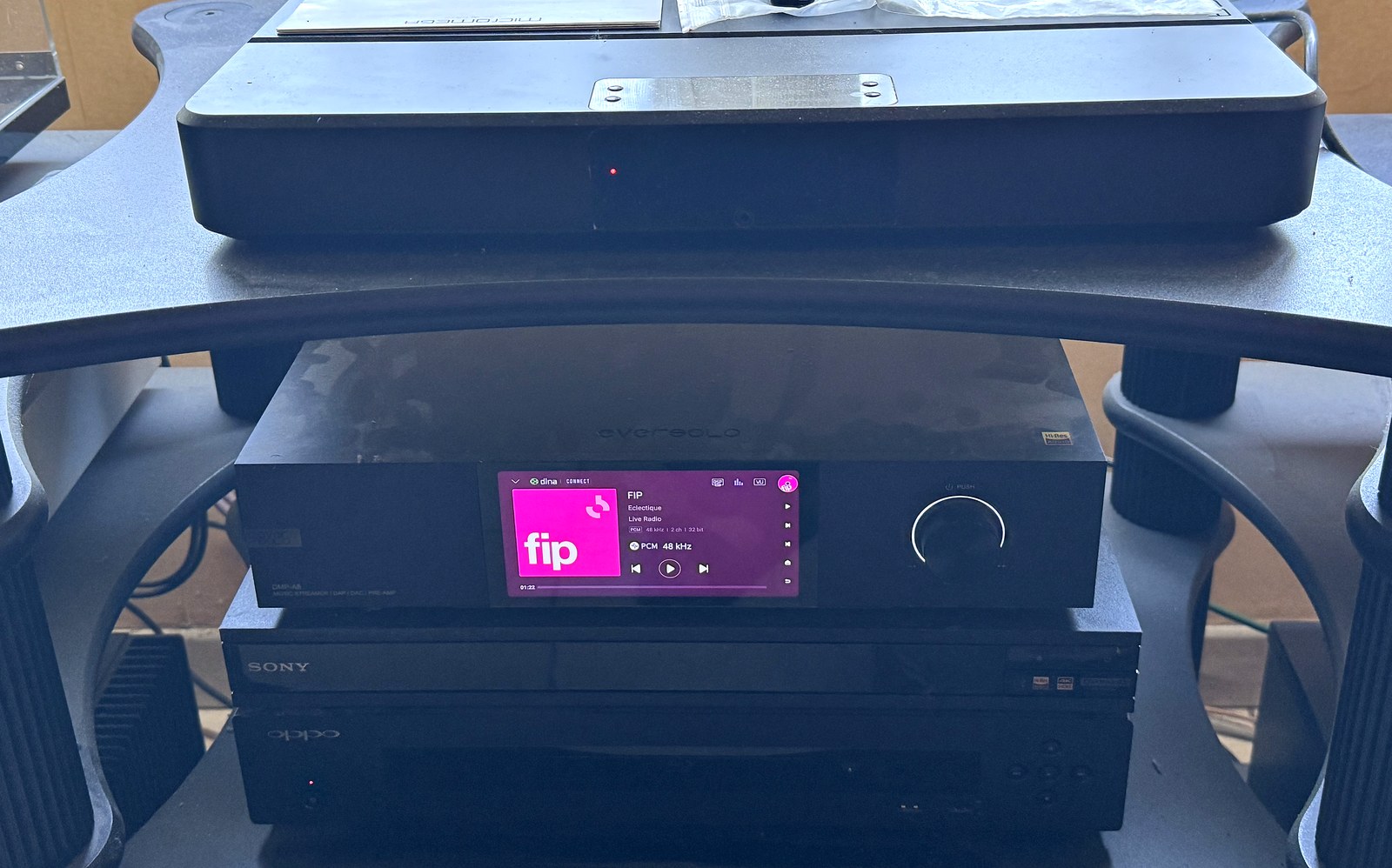
My current Roon-free setup on one of my systems: Eversolo DMP-A8 + Sony + Oppo, orchestrated by Tune via DLNA/UPnP.
What really worked well
Let's be honest: Roon delivered on its technical promises for several years.
- Metadata. The TiVo editorial content is unmatched: biographies, exhaustive credits, side-men cross-links. I discovered more music in 5 years of Roon than in 10 years of Spotify.
- RAAT and multi-room sync. Bit-perfect, sub-millisecond, never a drop between kitchen, living room and terrace. The benchmark remained the reference.
- The app. Slow on the first-gen iPad mini, but fluid on the iPad Pro. Browsing by credits/genre/era is addictive.
If you're still hesitating between the two, the complete Tune vs Roon 2026 comparison details where each one wins today.
2023: the Harman/Samsung acquisition and the first warning
May 2023: Roon Labs is acquired by Harman International, a subsidiary of Samsung Electronics. The official press release talked about "continuity" and "increased investment". Everyone wrote the same thing at the time, including magazine-audio.com.
My reading in 2026: Harman = JBL, AKG, Mark Levinson, Lexicon. None of these worlds are meant to coexist with an open ecosystem. When a large group buys a niche publisher, the history of the audio market (Sooloos, Meridian, Linn Songcast) shows that the roadmap always converges toward the group's in-house hardware and the gradual closing of the third-party SDK.
It didn't happen abruptly. But the pace of new features dropped in 2024, and community feedback on Reddit (/r/roon) shifted in tone: fewer release parties, more "Roon is becoming Sonos" threads.
Roon: it's expensive, especially for the middle class
The Roon lifetime license went from $499 (2018) to $699 (2021) to $829.99 (2025). +66% in 7 years, with no major upside on features for the end user. The annual subscription followed: $119 → $149.88.
Too expensive for me to switch: I stuck with my annual subscription.
For the complete 5-year TCO comparison between pure streaming and a self-hosted server, I detailed the numbers in self-hosted vs cloud in 2026.
Gradual closing of the ecosystem
Roon never added Spotify. Or Apple Music. Or Deezer.
Refusing Spotify is a defensible ideological choice (compressed audio quality, refusal to pay Spotify for the API). But in 2026, the technical argument is losing relevance: Spotify announced a lossless tier (see our detailed assessment), even if the rollout still needs to be confirmed on the audiophile side. That leaves the commercial argument — and that's where you hit the wall.
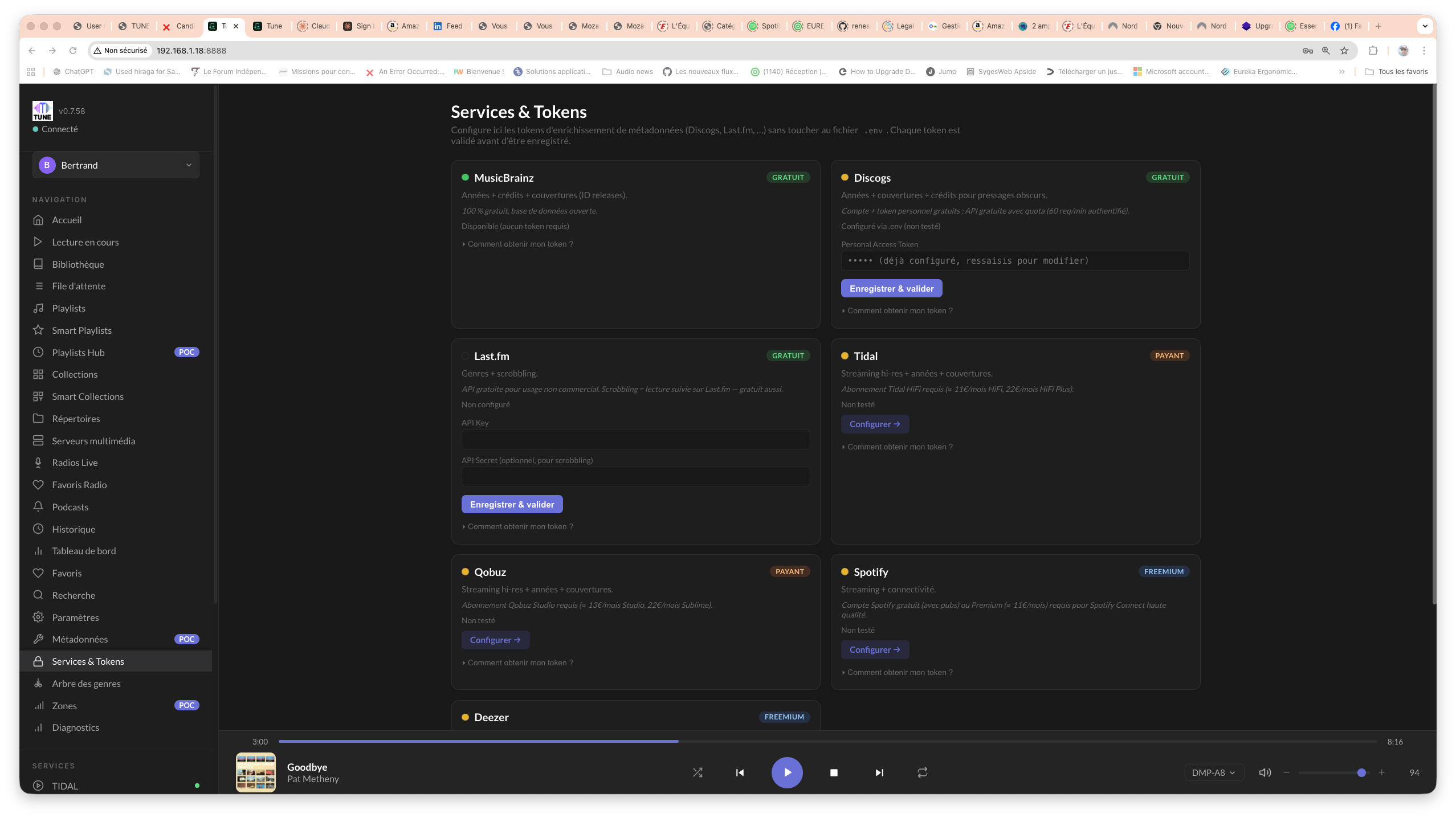
Tune notably aggregates Tidal, Qobuz, Deezer (plus Spotify catalog browsing) into a single library. Roon still refuses Spotify and Apple Music while Tune allows it under certain conditions:
- the Spotify catalog can be browsed in Tune, while playback goes through Spotify Connect, directly on the device,
- Apple Music is usable with Tune but for local playback on Apple devices.
And then? What I put in its place
I kept the Mac mini and installed Tune first in parallel with Roon. Short on cash, I didn't renew my annual subscription. The local library (~30,000 FLACs) was scanned over several years.
The transfer details (Roon export, endpoint mapping, recreating bookmarks as smart playlists) are in migrating from Roon to Tune in 30 minutes. What I missed about Roon for the first 2 months: the TiVo biographies and the editorial "focus" engine. What I never regretted: the subscription, the hardware dependency, the refusal of Spotify.
If you're in the same situation and still hesitating, also take a look at freeing your Sonos ecosystem — the logic of getting out of an audio walled garden is the same.
Frequently asked questions
Is Roon really going to disappear?
No, not in the short term. But the history of Samsung/Harman acquisitions in audio (HKaudio, AMX) shows a trajectory of gradual closure and vertical integration. On a 5-10 year horizon, I would no longer have bet on an independent publisher.
What should I do with my Nucleus if I leave Roon?
Reselling it second-hand (HiFi forums, Audiogon, eBay) is easy at 50% of the new price. Otherwise, it can be reflashed as a generic Linux server to run Tune or Logitech Media Server.
Is there a source-available alternative equivalent to Roon?
Tune is the most mature option in 2026. Logitech Media Server still has an active community but the UX dates from the 2010s. Volumio is fine for an endpoint but limited on multi-room and library sides.
Is the Roon discovery engine really worth the price?
Honestly, yes — it's the only argument that's truly hard to replace. But it represents 10% of my actual usage. For 90% of the rest (playback, multi-room, smart playlists), I no longer need it.
Try Tune
Tune is free, source-available (BSL 1.1), and keeps the original Roon philosophy: music first, user control second, no lock-in.
Further reading
- Tune vs Roon: complete 2026 comparison
- Migrating from Roon to Tune in 30 minutes
- Self-hosted vs cloud: owning your music in 2026
- Migrating from JRiver to Tune (convolutions)

Bertrand Clech — Founder of Mozaik Labs, creator of Tune. 40 years of audiophilia, DIY speaker builder (Supravox 215 TQWT, Supravox Jensen 285), REW measurements + miniDSP 2x4 HD Dirac DSP.