Tune vs Roon: the complete 2026 comparison
The essentials
- Roon costs $14.99/month or $829.99 lifetime; Tune is free and source-available (BSL 1.1), hosted on your own hardware (Pi, NAS, Mac, Linux).
- Tune wins on price, openness (native DLNA/AirPlay/Sonos), and Tidal/Qobuz/Deezer (plus Spotify catalog browsing) aggregation in a single library; Roon for now keeps the lead on advanced DSP (multi-channel convolution, integrated room correction) and the certified RoonReady ecosystem.
- For 80% of audiophiles (home multi-room, large local catalog + streaming, smart playlists), Tune is more than enough and saves you at least 150 €/year.
Contents:
- Pricing: $829 vs free
- Metadata and library
- Integrated streaming services
- Multi-room and endpoints
- DSP, convolution and room correction
- Roon Ready versus Tune Proxy
- Summary table
- Verdict: which one to pick in 2026?
- Frequently asked questions
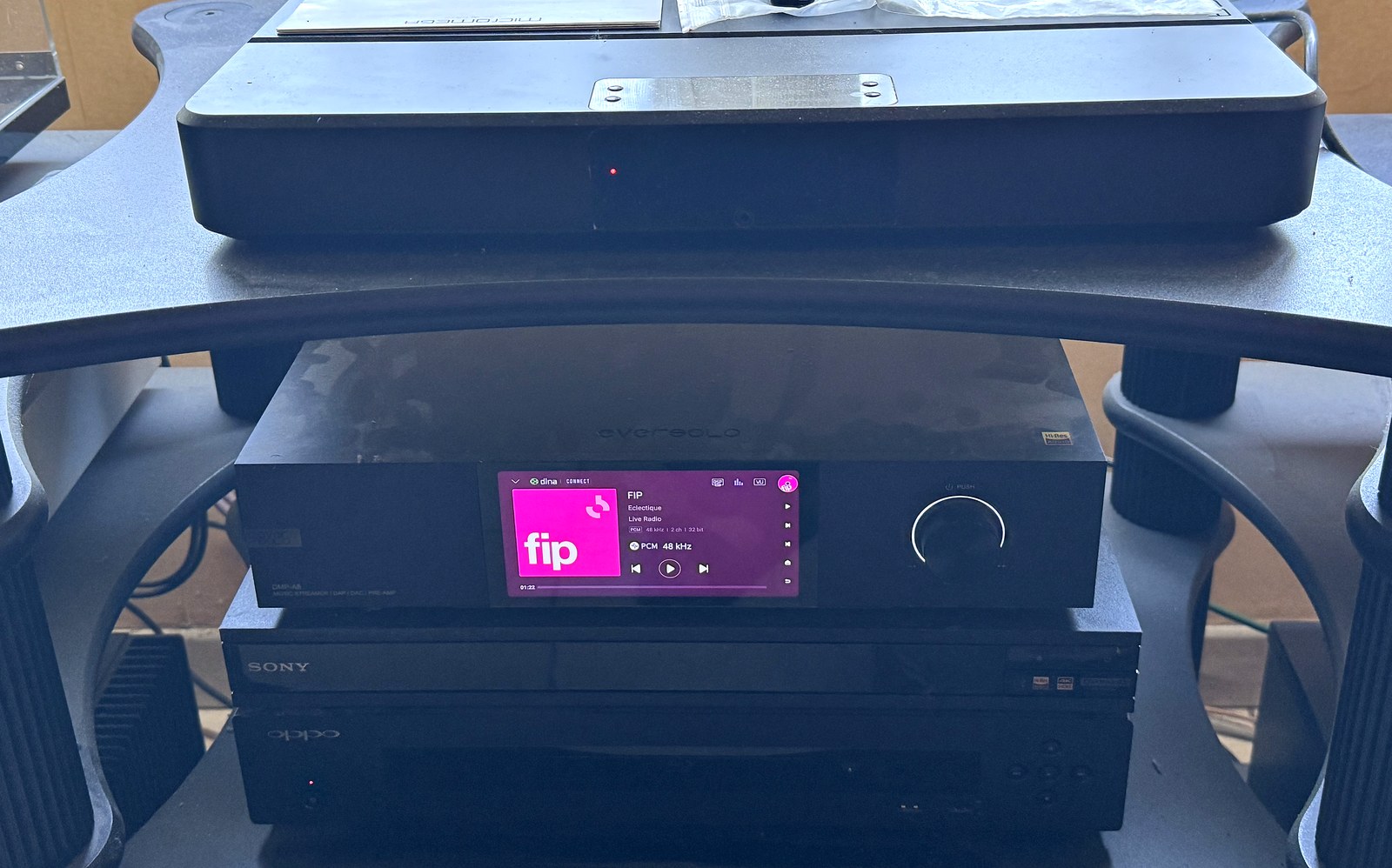
A typical non-Roon Ready audiophile setup: Eversolo DMP-A8 + Sony + Oppo. Tune orchestrates them via DLNA/UPnP, with no RoonReady certification required.
Roon or Tune? In a modern chain, the choice of software weighs as much as the DAC.
How much does Roon cost in 2026 versus Tune?
Roon charges $14.99/month, $149.88/year or $829.99 lifetime. Tune is free, source-available (BSL 1.1), and runs on any hardware you already own. Over 5 years, Roon's annual subscription comes to $750; the lifetime plan is an $830 upfront investment, with the risk of seeing the publisher disappear or change hands — which already happened with the Harman/Samsung acquisition in 2023.
Roon also imposes heavy hardware lock-in: the official Nucleus starts at €2,500, the Nucleus+ at €3,800. You can work around it with a self-installed ROCK on a NUC, but you step outside the support perimeter. Tune runs natively on Raspberry Pi 4 (€60), Synology, QNAP, Mac mini, Intel/AMD Linux, with no licence to pay.
If you want the full accounting of return on investment between pure streaming and a self-hosted server, we ran the 5-year TCO numbers in owning your music in 2026: self-hosted vs cloud.
Metadata: Roon invented the category, Tune is closing the gap
Roon is famous for its editorial metadata (biographies, credits, links between artists) sourced from its TiVo/Rovi partnership. Tune uses MusicBrainz, Discogs, AcousticBrainz and the Tidal/Qobuz APIs to fetch covers, credits, years, genres and artist relationships.
In practice, on a 50,000-track library, the gap is less glaring than it was in 2018. Tune finds 95%+ of covers in HD, fills in engineer/producer credits on Tidal/Qobuz editions, and automatically rebuilds the genre hierarchy (see self-hosted music server guide). Where Roon retains an edge: long-form biographies, editorial liner notes, and the automatic link between a side-man and his own albums.
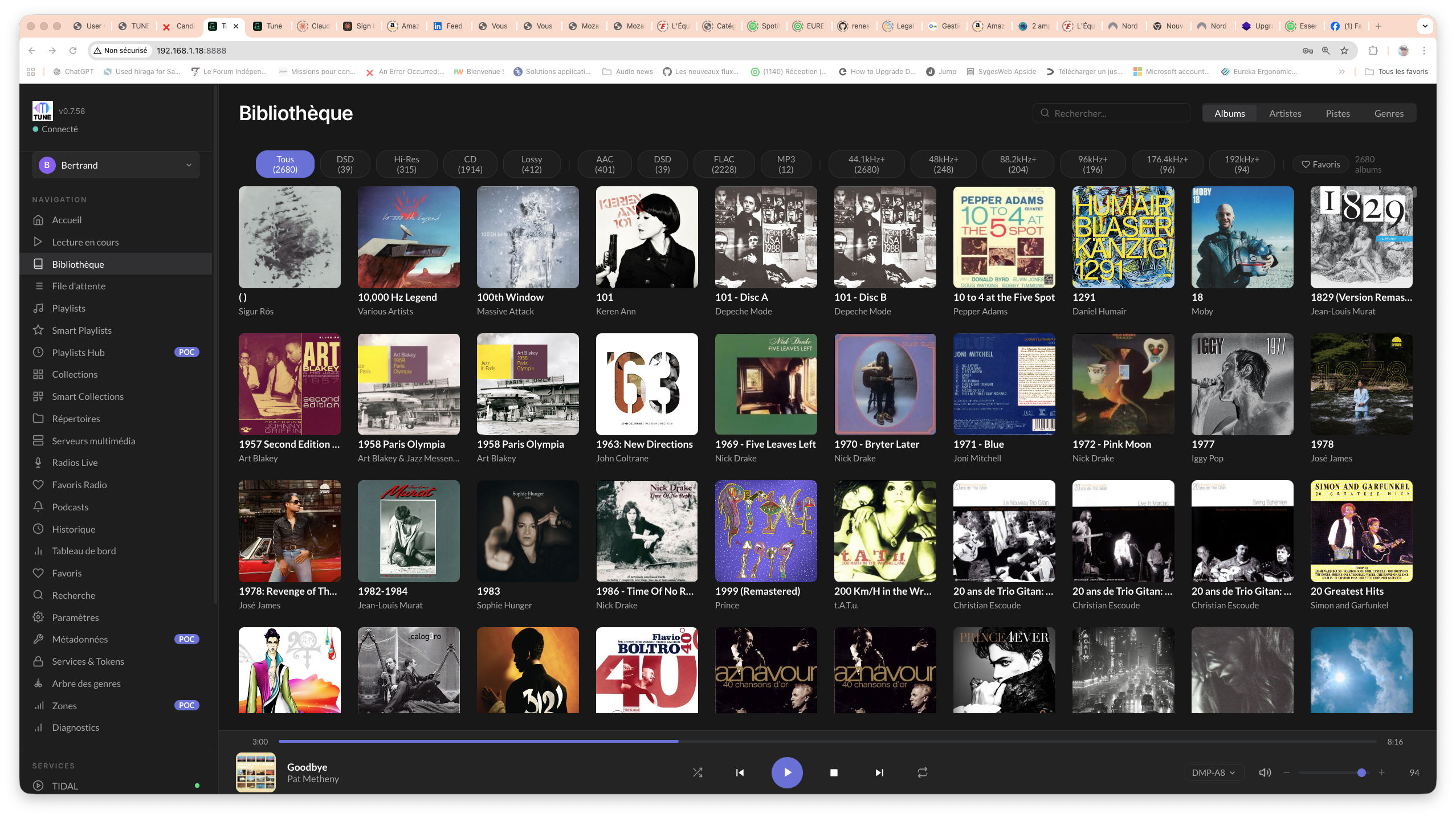
Tune unifies Tidal, Qobuz, Apple Music (plus Spotify catalog browsing) and your local library into a single view.
Tune Library: HD covers, credits and release years fetched automatically.
Streaming services: advantage Tune
Roon supports Tidal and Qobuz only. Tune natively integrates Tidal, Qobuz, Deezer and Apple Music (plus Spotify catalog browsing) (iOS/macOS), with a unified library and smart playlists that can cross-reference catalogs. This is where Roon shows its age the most: historical refusal of Spotify, no Deezer, no Apple Music.
For an audiophile who wants Hi-Res on Qobuz, Tidal's exhaustive jazz catalog, and wants to keep Spotify for collaborative playlists with the family, Tune brings Tidal, Qobuz and your library together in a single view, without workarounds; the Spotify catalog can be browsed there, while Spotify playback goes through Spotify Connect, directly on the device. See cross-service smart playlists Tidal/Qobuz for concrete use cases.
Multi-room: native DLNA/AirPlay/Sonos vs RoonReady
Roon requires RoonReady or RAAT for native bit-perfect playback. Tune speaks DLNA, AirPlay 1/2, Chromecast Audio, Sonos and UPnP natively, with no certification. In practice: your old Naim DAC, your Zidoo Z3000, your Linn Klimax DS, your Yamaha AVR, your WiiM Pro all work immediately with Tune. With Roon, you need either certified RoonReady gear (DACs at €1,000+) or a Roon Bridge endpoint as an intermediary.
For honest home multi-room (kitchen + living room + bedroom + terrace), Tune handles zone-group sync, central volume control, and Now Playing display sync. Roon stays more accurate on sub-millisecond sync in a pure RoonReady installation. To go further on the open alternative: multi-room audio without Sonos.
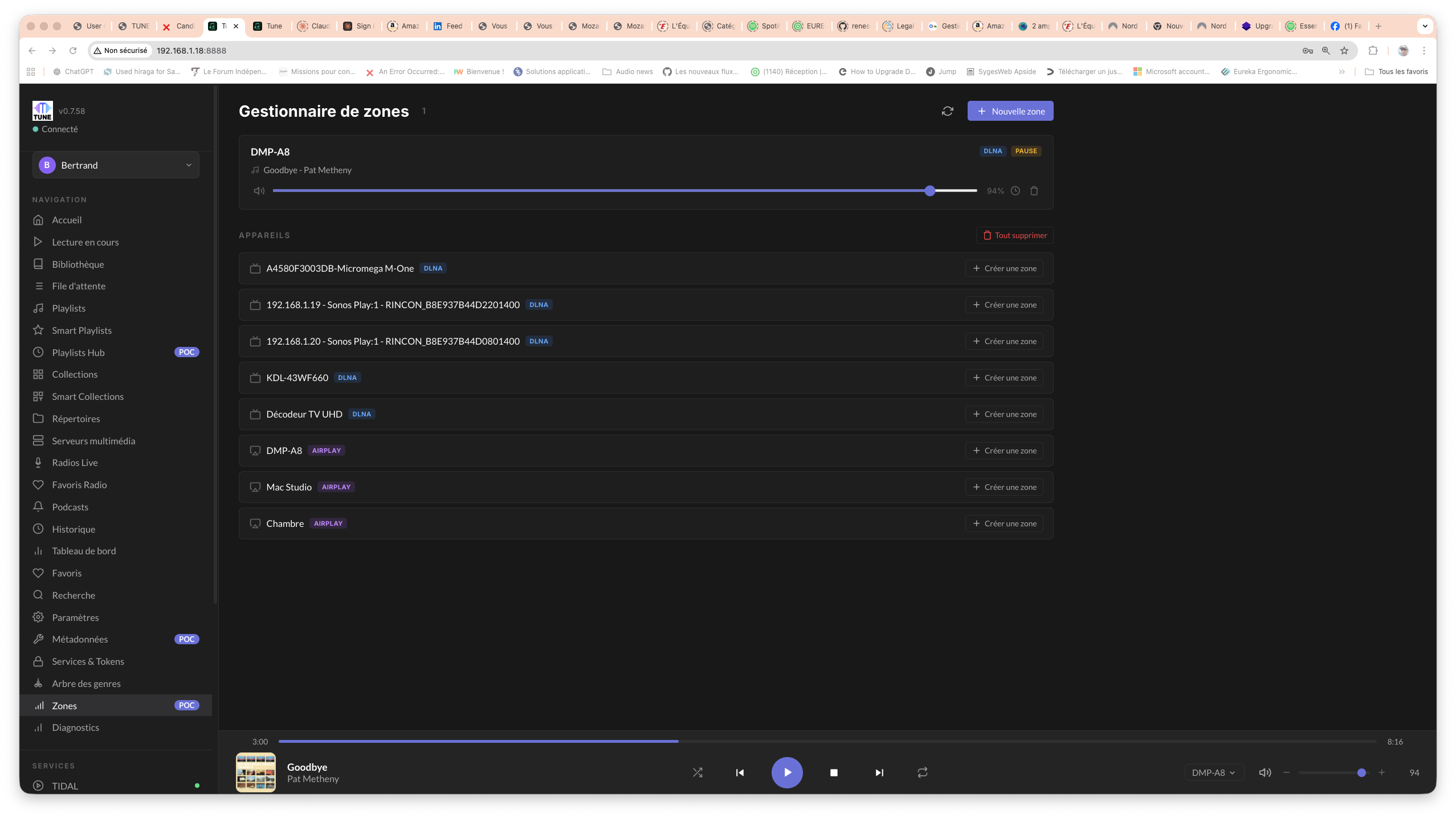
Tune multi-room: native DLNA, AirPlay and Chromecast, no certified hardware required.
Tune zone management: DLNA, AirPlay and Sonos all in the same interface.
DSP, convolution and room correction
This is the area where Roon keeps a real lead. Roon ships a complete DSP engine: parametric EQ, convolution (FIR filters up to 64 channels), DSD512 upsampling, headroom management, room correction. Tune currently offers parametric EQ, stereo convolution (.wav filters generated by REW or Acourate), and upsampling up to DSD256 depending on the DAC.
If you use REW + a UMIK-1 microphone to measure your room and apply acoustic correction, Tune can do it — but in stereo, not multi-channel. For the 2.0 or 2.1 audiophile that's enough. For 5.1.4 home cinema with per-speaker correction, Roon (or JRiver) stays ahead. We documented the full workflow in Tune + REW: automatic acoustic correction.
Roon Ready versus Tune Proxy
Roon imposes its licence, while Tune — at the cost of a few hours of work — makes unsupported devices compatible. As an example, a friend handed me an excellent Micromega M-ONE 150 — no longer actively supported with firmware updates. Despite those limitations, I had to account for the device's quirks (no HTTPS streams supported, blocking redirects, etc.) and make Tune handle the device correctly. It then acts as a smart proxy!
Tune vs Roon summary table
| Criterion | Roon (2026) | Tune (2026) |
|---|---|---|
| Price | $14.99/month or $829.99 lifetime | Free (optional Premium), source-available (BSL 1.1) |
| Server platforms | ROCK, Nucleus, macOS, Windows, Linux | Linux (Pi/NAS), macOS, Windows (Docker in the works) |
| Metadata | TiVo/Rovi (premium editorial) | MusicBrainz + Discogs + Tidal/Qobuz |
| Streaming | Tidal, Qobuz | Tidal, Qobuz, Deezer, Apple Music (plus Spotify catalog browsing) (via Mac) |
| Native multi-room | RoonReady, RAAT, AirPlay (limited) | DLNA, AirPlay 1/2, Sonos, Chromecast, UPnP |
| DSP | EQ + multi-channel convolution + room correction | EQ + stereo convolution (REW) |
| Cross-service smart playlists | No | Yes (Soundiiz-style orchestrator) |
| Public source code | No | Yes (BSL 1.1) |
| Vendor risk | Acquired by Harman/Samsung in 2023 | Community code, fork possible |
Verdict: which one to pick in 2026?
Pick Roon if you've already invested in a RoonReady ecosystem (certified DAC, multiple endpoints), you do multi-channel home cinema with advanced convolution, or you value the TiVo editorial layer and accept the recurring cost.
Pick Tune if you pay for Roon with a wince, you want to aggregate Deezer/Apple Music (plus Spotify catalog browsing) on top of Tidal/Qobuz, you use standard UPnP/DLNA gear, or you refuse to depend on a publisher acquired by a major group. Migration takes 30 minutes: step-by-step tutorial here.
For an honest field report from someone who left Roon after 4 years of use, see why I left Roon after 4 years. To dig into Hi-Res streaming ecosystem choices, the Tidal vs Qobuz vs Apple Music Hi-Res comparison rounds out the picture nicely. The site audiophonics.fr has also published several reviews of DLNA transports compatible with Tune.
Frequently asked questions
Can Tune import my Roon library?
Yes, indirectly. Tune scans the same FLAC/ALAC/DSF folders Roon uses. Roon playlists export to M3U and import into Tune. Roon bookmarks (smart playlists) have to be recreated in Tune, but the smart playlists engine is more powerful.
Does Tune support RoonReady DACs?
Yes. Every RoonReady DAC also embeds UPnP/DLNA or AirPlay (it's a requirement of the underlying protocol). You use Tune via DLNA and you keep your hardware. Bit-perfect is preserved as long as the DAC accepts the native format.
How much horsepower do I need to run Tune on a Raspberry Pi?
A Pi 4 with 4 GB is enough for 100,000 tracks and 4 simultaneous zones. For parallel stereo convolution or 500,000+ libraries, aim for a NUC i3 or a Mac mini M1.
Does Tune do bit-perfect DSD?
Yes, up to DSD256 depending on the DAC, in DoP or natively via DLNA RAW. Convolution forces conversion to PCM (a physical limitation, not a software one).
What happens to my Roon lifetime licence if I migrate?
It stays valid; you can run both in parallel during the transition. Roon licences are resellable second-hand (HiFi forums, eBay) at €400-500 on average in 2026.
Try Tune
Tune 1.0 is at release-candidate stage, free, with optional Premium; it runs on Linux, macOS, Windows and Docker. Install it in 10 minutes and compare it for yourself against your Roon Core.
Further reading
- Why I left Roon after 4 years
- Migrate from Roon to Tune in 30 minutes
- Self-hosted vs cloud music: 2026 comparison
- Self-hosted music server guide 2026

Bertrand Clech — Founder of Mozaik Labs, creator of Tune. 40 years of audiophile passion, DIY speaker builder (Supravox 215 TQWT, Supravox Jensen 285), REW measurements + miniDSP 2x4 HD Dirac DSP.